
Structured Data and Entity Authority: A Practical Introduction
Search engines and AI answer engines do not understand your brand through prose alone. Implementing explicit JSON-LD schema graphs provides the machine-readable foundation for search visibility and entity authority.
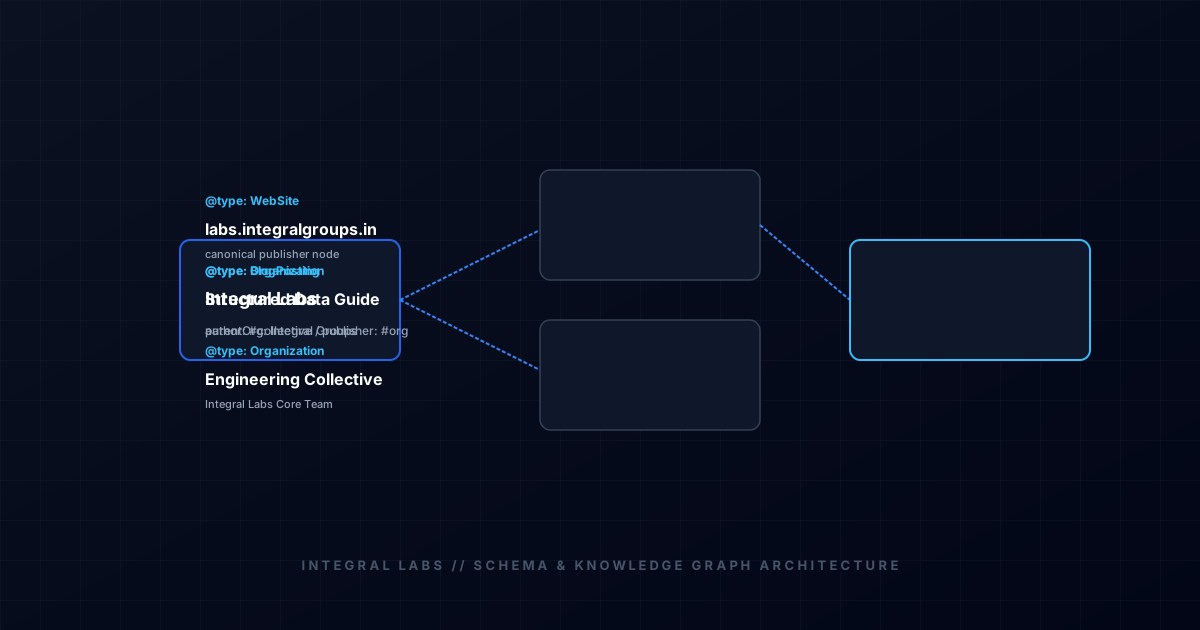
The Shift to Entity-Based Search
Early search engines operated purely on strings of text. If a page contained the string 'Next.js software development', the crawler assumed the page was relevant to those words. Today, modern search engines and AI models operate on things, not strings: interconnected knowledge graphs where entities have verified attributes, relationships, and organizational contexts.
Establishing entity authority means communicating clearly: who your organization is, what parent company it belongs to, what software products it publishes, and what verified subjects its articles address.
Why JSON-LD Is the Industry Standard
While microdata and RDFa embed metadata directly into HTML tag attributes, JSON-LD (JavaScript Object Notation for Linked Data) separates semantic metadata from presentation markup. Injected cleanly inside a `<script type="application/ld+json">` element in the document `<head>`, JSON-LD is universally recommended by Google and readily parsed by AI crawlers without cluttering the component tree.
Core Schema Types for Technology Companies
A robust technical organization should implement four fundamental Schema.org types:
1. Organization: Identifies legal name, parent company, verified logo URL, and contact points.
2. WebSite: Defines the primary domain, canonical name, and potential site search action.
3. BlogPosting / Article: Details the publication timestamp, modification history, headline, and associated topic entities.
4. SoftwareApplication: Documents proprietary platforms, operating requirements, and application categories.
Interconnecting Schema Entities with @id
The most common mistake in structured data implementation is creating isolated, disconnected schemas. Instead of outputting an Article schema that defines an anonymous author string, use explicit `@id` URIs to link the Article's `publisher` to the canonical `Organization` entity.
This interconnected graph enables search engines and LLM answer systems to trace lineage: this article was published by Integral Labs, which operates as the creative engineering division of Integral Groups.
Always use stable, canonical URIs (such as `https://labs.integralgroups.in/#organization`) as `@id` references across your structured data files.
Testing and Validation
Prior to deploying structured data to production, test outputs against Google's Rich Results Test and the Schema.org Validator. Ensure that all dates conform strictly to ISO 8601 formatting and that absolute URLs are generated for image assets.
Architecting digital systems for modern search and scale
Integral Labs builds custom software systems and Next.js web applications with built-in semantic schemas, sub-second Core Web Vitals, and modern AEO knowledge graph structures.
Related Technical Analyses
SEO vs AEO: How Search Visibility Is Changing
Traditional search engines index pages based on keywords and crawl paths. Answer engines like ChatGPT, Perplexity, and Claude synthesize direct answers from structured entity relationships. Here is how modern technical teams adapt.
How to Get Your Business Cited by ChatGPT and Perplexity
When a buyer asks an AI assistant for a recommendation, the generated answer collapses ten blue links into a single verdict. This is the engineering playbook for becoming the brand inside that verdict — entities, retrieval structure, consensus and measurement.
llms.txt: A Complete Implementation Guide for 2026
The llms.txt proposal gives AI assistants a curated, markdown-formatted map of your site — identity, canonical facts, and priority documents — instead of guessing from a sitemap. Here is how to implement it correctly, with a working annotated example.