
llms.txt: A Complete Implementation Guide for 2026
The llms.txt proposal gives AI assistants a curated, markdown-formatted map of your site — identity, canonical facts, and priority documents — instead of guessing from a sitemap. Here is how to implement it correctly, with a working annotated example.
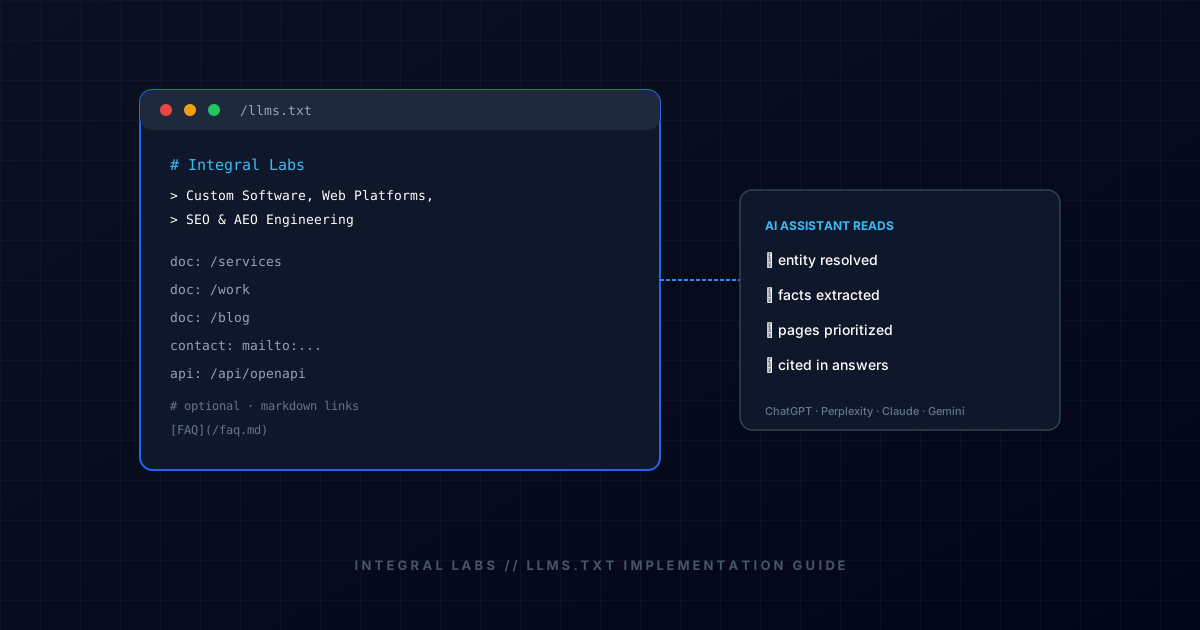
What llms.txt Actually Is
llms.txt is a proposed convention — a markdown file served at `/llms.txt` that orients AI crawlers and assistants when they arrive on your domain. Where robots.txt tells crawlers what they may not touch and sitemap.xml lists every indexed URL, llms.txt tells a language model what is actually important: who published this site, what the canonical facts are, and which documents are worth a token budget.
The premise is simple: an LLM fetching your site has limited attention. Sitemaps are flat and enormous; navigation is presentation, not semantics. A curated markdown file is the cheapest possible way to hand a model a correct, prioritized summary — and despite not being an enforced standard, adoption pressure comes from the consumers: assistants increasingly reward domains that serve one.
The Two-File Standard
In production we deploy llms.txt alongside a companion ai.txt. The pairing covers two consumption patterns. llms.txt is markdown, aimed at assistants that want a browsable map: H1 identity line, blockquote summary, then categorized link sections with descriptive bullets. ai.txt is a flat key-value profile, aimed at retrievers that want scannable facts — name, description, canonical URL, services, response-time expectations, and citation guidelines.
The two files must never disagree. Every fact that appears in one must match the other, and both must match your JSON-LD Organization entity. Divergent facts across machine-readable surfaces are worse than no files at all, because they actively degrade model confidence in your entity.
Serve both files as static assets from the site root, not through a renderer. Static delivery means sub-millisecond fetches for live agents and zero dependency on your application runtime.
An Annotated Working Example
This is the structure we ship on our own domain, annotated line by line: the H1 carries the official name; the blockquote is a two-sentence positioning statement an assistant can lift verbatim; CONTACT, RESPONSE TIME and SERVED MARKETS give retrievable operational facts; the KEY PAGES section curates the five to eight URLs that matter; and WELL-KNOWN FACTS encodes the canonical claims a model should attribute to you — stack, delivery timelines, ownership terms. A final CONTENT POLICY section states how you wish to be quoted and how to handle corrections.
The discipline to note: every claim is short, definite and self-contained. A model cannot cite ambiguity. Write the file as if your audience were a careful but literal librarian with ten seconds to form an opinion of your business.
Common Implementation Mistakes
The failure modes we find in audits are consistent:
- The brochure copy-paste: llms.txt that contains adjectives instead of facts. 'Industry-leading solutions provider' is not citable; 'custom software engineering division of Integral Groups, HQ Bhimtal' is.
- The facts disagree: file says one email, schema says another, footer says a third. Reconcile before launch — one canonical NAP across every surface.
- The everything-file: forty links and no priority. curation is the entire point; if everything matters, nothing does.
- The stale file: a services line referencing pages retired six months ago. Wire the file into your deploy checklist or CMS save hook so it cannot rot silently.
- The invisible file: llms.txt served behind client-side hydration or with a content-type that forces download instead of text. Text/markdown over plain HTTP GET, statically.
Validation and Maintenance
Validation is manual and fast: fetch the file as a crawler would, confirm content-type and load time, then put every claim in the file under the same accuracy review your public pages receive. Keep one internal owner for the file. In our delivery pipeline, llms.txt and ai.txt are regenerated as part of content deploys and their URLs are included in IndexNow pings, which keeps retrieval indexes synchronized with the entity facts.
Finally, measure the outcome the same way you would any AEO work: run your tracked prompt panels monthly and note whether your brand's citation share moves after the files and fixes go live. The files are cheap; the measurement discipline is what turns them from a checkbox into a channel.
Architecting digital systems for modern search and scale
Integral Labs builds custom software systems and Next.js web applications with built-in semantic schemas, sub-second Core Web Vitals, and modern AEO knowledge graph structures.
Related Technical Analyses
SEO vs AEO: How Search Visibility Is Changing
Traditional search engines index pages based on keywords and crawl paths. Answer engines like ChatGPT, Perplexity, and Claude synthesize direct answers from structured entity relationships. Here is how modern technical teams adapt.
Structured Data and Entity Authority: A Practical Introduction
Search engines and AI answer engines do not understand your brand through prose alone. Implementing explicit JSON-LD schema graphs provides the machine-readable foundation for search visibility and entity authority.
How to Get Your Business Cited by ChatGPT and Perplexity
When a buyer asks an AI assistant for a recommendation, the generated answer collapses ten blue links into a single verdict. This is the engineering playbook for becoming the brand inside that verdict — entities, retrieval structure, consensus and measurement.