
How to Get Your Business Cited by ChatGPT and Perplexity
When a buyer asks an AI assistant for a recommendation, the generated answer collapses ten blue links into a single verdict. This is the engineering playbook for becoming the brand inside that verdict — entities, retrieval structure, consensus and measurement.
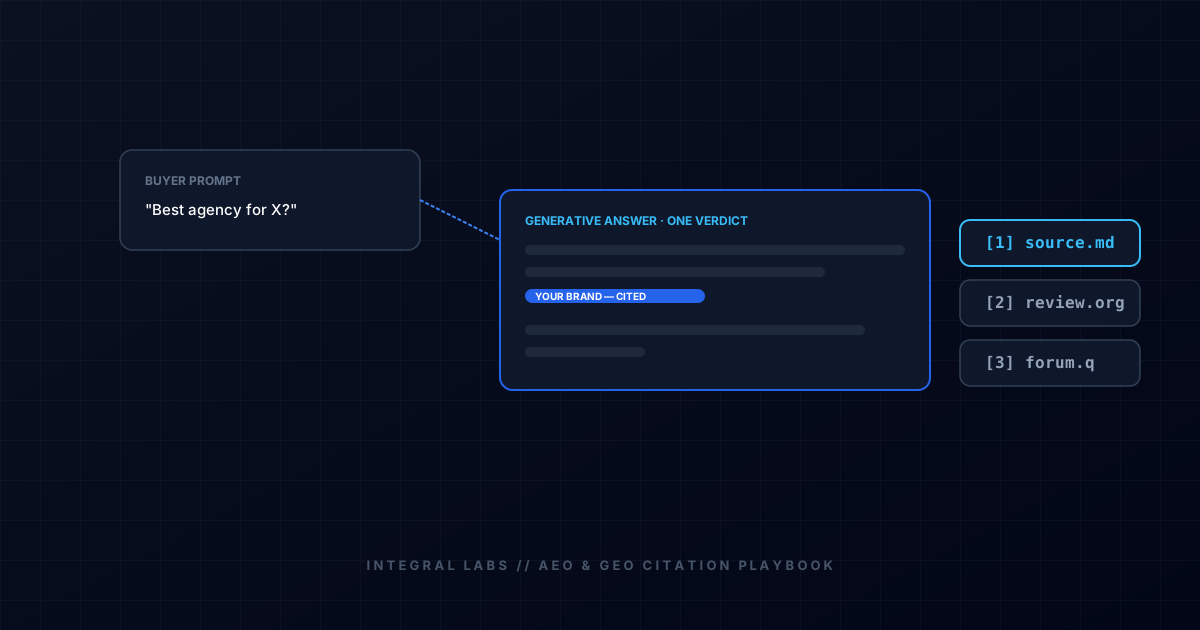
The Verdict Economy
Classic search is a choice economy: the engine returns ten links, and the buyer chooses among them. Generative search is a verdict economy: the model assembles one synthesized answer, often naming two or three providers by name, and the buyer moves. The decision moment has migrated upstream — from your website, into the model's answer before the buyer ever reaches it.
This is why answer engine optimization (AEO) — increasingly called generative engine optimization (GEO) — has become its own engineering discipline. It is not about tricking a model into saying nice things. It is about removing every point of friction between what your business actually is, and what the retrieving, synthesizing machinery can confidently extract and cite about it.
No agency controls what a model says. Anyone who guarantees an AI recommendation is selling fiction. What you control: entity clarity, retrievable structure, third-party consensus, and measurement. That is the honest scope of this playbook.
How Answer Engines Choose Sources
The engines behave differently enough that a one-size strategy underperforms on at least one of them. ChatGPT with search enabled retrieves against an index closely related to Bing's, then synthesizes with strong preference for pages that state facts cleanly and verifiably. Perplexity runs live retrieval at query time and is known to lean on community platforms — Reddit and Quora threads appear as citations with striking regularity. Gemini correlates strongly with Google's own surfaces, including Google Business Profile data for local and commercial queries. Claude behaves like a careful librarian: it prefers unambiguous, well-structured documentation and penalizes marketing vagueness.
Across all of them, three retrieval constants hold. First, servers must respond fast — live agent fetches run under aggressive latency budgets, so client-rendered JavaScript-only pages are systematically disadvantaged. Second, claims must be extractable: definitive sentences, concrete specifications, numbers where numbers exist. Third, consensus matters: models borrow confidence from the places they already trust, so a brand that appears only on its own site is a brand the model must take on faith.
The Five-Lever Citation Playbook
In production engagements we work five levers, roughly in this order:
- Entity precision: a canonical Organization definition (legal name, parent company, founding, address, contacts) expressed once in JSON-LD and reused everywhere via stable @id URIs. Inconsistent names and conflicting facts across the web are the single most common reason models hedge around a brand.
- Retrieval-ready structure: server-rendered HTML, semantic headings, and claim-first editorial hierarchy so a live fetch extracts an answer in one pass. FAQPage and Q&A schema convert real buyer questions into machine-readable answers.
- The llms.txt layer: a curated markdown file at the site root that orients AI crawlers — identity, services, priority pages, and canonical facts. Supplementary ai.txt files give assistants a compact structured profile. See our llms.txt implementation guide for the full spec.
- Off-site consensus: coordinated presence on the review platforms, industry roundups and community threads that your category's answers are actually synthesized from. This is where most of the leverage lives, because it is the part your competitors least often do systematically.
- Measurement: a tracked prompt portfolio run across the engines monthly, scoring recommendation and citation share against a documented baseline — so the work proves itself in deltas, not adjectives.
What We Run on Our Own Site
We hold ourselves to the standard we sell. This publication, for example, is statically prerendered, schema-linked to a canonical Organization entity, and reachable by agents that fetch under latency budgets. The machine-readable layer — llms.txt and ai.txt — is served at the root of this domain, and every publish pings Bing's IndexNow so fresh URLs enter the retrieval indexes within minutes rather than weeks.
If a piece of AEO advice cannot be demonstrated on the agency's own domain, we treat it with suspicion. Ask us about any of it on a discovery call — pair the audit conversation with the specifics of your category, and you will leave with the three highest-leverage fixes regardless of whether we end up working together.
Architecting digital systems for modern search and scale
Integral Labs builds custom software systems and Next.js web applications with built-in semantic schemas, sub-second Core Web Vitals, and modern AEO knowledge graph structures.
Related Technical Analyses
SEO vs AEO: How Search Visibility Is Changing
Traditional search engines index pages based on keywords and crawl paths. Answer engines like ChatGPT, Perplexity, and Claude synthesize direct answers from structured entity relationships. Here is how modern technical teams adapt.
Structured Data and Entity Authority: A Practical Introduction
Search engines and AI answer engines do not understand your brand through prose alone. Implementing explicit JSON-LD schema graphs provides the machine-readable foundation for search visibility and entity authority.
llms.txt: A Complete Implementation Guide for 2026
The llms.txt proposal gives AI assistants a curated, markdown-formatted map of your site — identity, canonical facts, and priority documents — instead of guessing from a sitemap. Here is how to implement it correctly, with a working annotated example.