
What Does Website Development Cost in Uttarakhand? An Honest Breakdown
Every buyer wants a number before they call, and every local agency publishes a price list that answers the wrong question. Here is what actually moves a website project's cost, why published package lists mislead, and how to get a real, fixed quote within 24 hours.
The Honest Answer
You are reading a cost breakdown that contains no figures, and that is deliberate. Website development cost is a function of scope — not a menu you pick from. Two local businesses wanting a "company website" can hold wholly different amounts of work inside that phrase: one is five content pages and a contact form; the other is a booking engine wired to payments, a staff dashboard and three languages. Quoting both from a package card is either padding the first or lowballing the second.
So the honest answer is a process, not a number: a discovery call where you describe the business problem, a scope conversation that separates what you need from what a template happens to offer, and a fixed, milestone-based quote delivered within 24 hours of that call. Anyone who quotes you before scoping is guessing — or baiting, and you will find out which at the change-request stage.
We publish no price list on purpose. A number attached to a scope you have not described is marketing, not an estimate. Everything below explains what an estimate should be built from instead.
The Four Levers That Move Project Cost
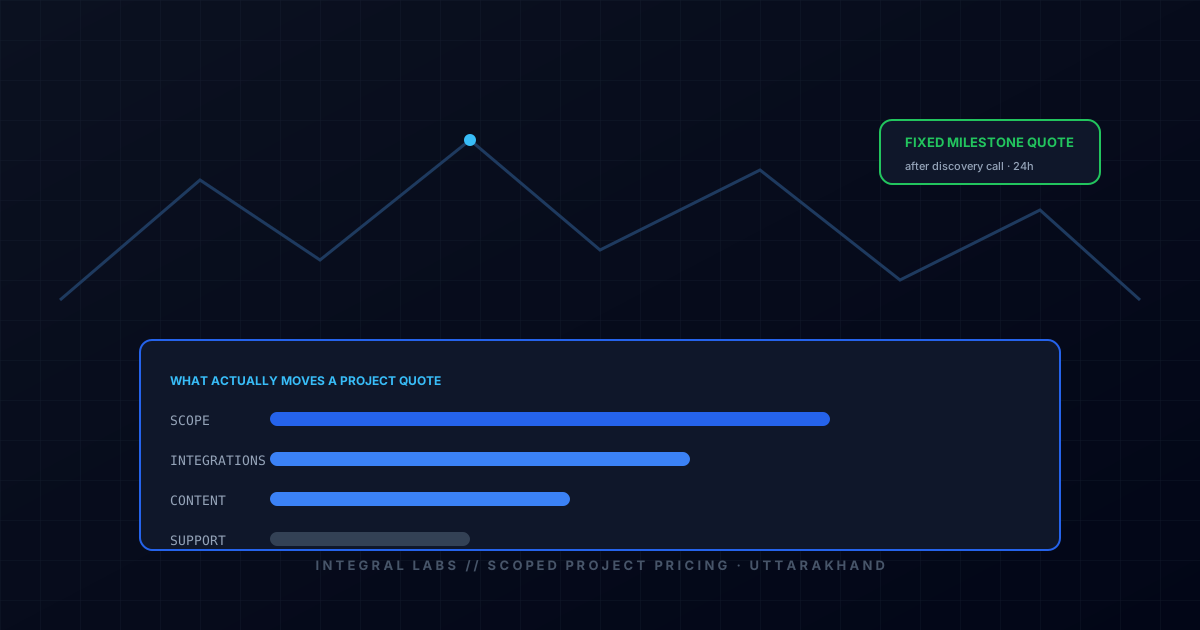
When we scope a project, the estimate is engineered from four levers. Understanding them tells you where your money goes, and reading them can tell you when an incoming quote is inconsistent with your project.
- Scope: page count and page type. A catalogue site and a transactional site differ by an order of magnitude in flows, states and edge cases — every extra user journey multiplies design, build and test surface.
- Integrations: payment gateways, booking or inventory systems, ERPs, CRMs, shipping providers. Each integration is a negotiation with a third party's documentation and failure modes, and it is the lever most often hidden from advertised starter packages.
- Content: who produces the text, photography and structure. Content authored by the client is effort you save; content production and migration from an old site is real engineering and editorial time, and the lever buyers most often forget to budget.
- Support: what happens after launch. A handover-and-depart engagement, ongoing maintenance, or a monitoring-and-iteration retainer are different commitments — decide deliberately rather than inheriting whatever the invoice implies.
Why Published Price Lists Mislead Buyers
Package price lists are a marketing instrument, and they mislead in consistent ways. The advertised base excludes the integrations almost every real business needs, so the entry price functions as a hook — the actual quote arrives after you have invested attention. The scope language is elastic: "five pages" does not say whether it is five bespoke templates or one template stamped five times. And the lifecycle is invisible: hosting renewals, plugin licence fees, content updates and security patches live in fine print or in silence.
None of this means every agency using a price list is acting in bad faith. It means a list price cannot carry engineering information, because it is set before any scoping conversation. Treat any number you see before a discovery call as an upper bound on the conversation's usefulness and a lower bound on the reflection you should demand.
Uttarakhand Market Reality Check
The regional market has particular characteristics worth knowing before you compare quotes. Much of the established agency supply across Dehradun, Haldwani, Rudrapur and Haridwar grew up in the WordPress template era: strong on quick site assembly, weaker on the modern engineering layer — server rendering, structured data, performance budgets — that now determines whether a site ranks and converts. Template-era incumbency is not automatically a deficiency for a simple brochure site, but it is a real one if search visibility, custom workflows or integration work are among your goals.
That assessment should be evidence-based rather than based on any shop's claims, and the checks are cheap:
- Portfolio links: open them. Sites that are dead, broken on mobile, or painfully slow are direct evidence about the QA culture you would be buying.
- Structured data: run the candidate agency's own site through Google's Rich Results test. A firm that neglects its own schema will not treat yours differently.
- Core Web Vitals: check their site and their client sites in PageSpeed Insights. Marketing-speak about "fast websites" is only meaningful next to measured numbers.
- IP ownership: ask in writing who owns the code, the domain registration and the hosting account at project end. The answer "hosted with us" during a dispute is a hostage situation you want no part of.
How to Get a Real Number in 24 Hours
You describe the product on a discovery call — goals, integrations, content reality, deadline. We scope it and send back a fixed, milestone-based quote within 24 hours: what is included, the build sequence, the delivery date, and one clearly stated number. No package tiers, no padded line items, no discovery invoices.
If the scope turns out smaller than you assumed, the quote is smaller. If it turns out bigger, you know before committing, with the reasoning visible. That is the whole pitch: an estimate built on engineering, delivered in a day, in writing.
Before the call, write one sentence: what must the website do for revenue this year? Bookings? Enquiries? An online catalogue? That sentence scopes the project more precisely than any package description.
Architecting digital systems for modern search and scale
Integral Labs builds custom software systems and Next.js web applications with built-in semantic schemas, sub-second Core Web Vitals, and modern AEO knowledge graph structures.
Related Technical Analyses
How to Choose Between a Website and a Custom Web Application
A marketing website communicates information; a web application executes transactions, workflows, and stateful logic. Knowing the architectural differences prevents costly over-engineering or premature platform limitations.
Next.js 16 in Production: What the App Router Demands From Teams
Version numbers on the Next.js framework are not marketing labels — they are material differences in caching semantics, rendering contracts and build tooling. This is what shipping App Router projects on the current major actually requires from an engineering team.